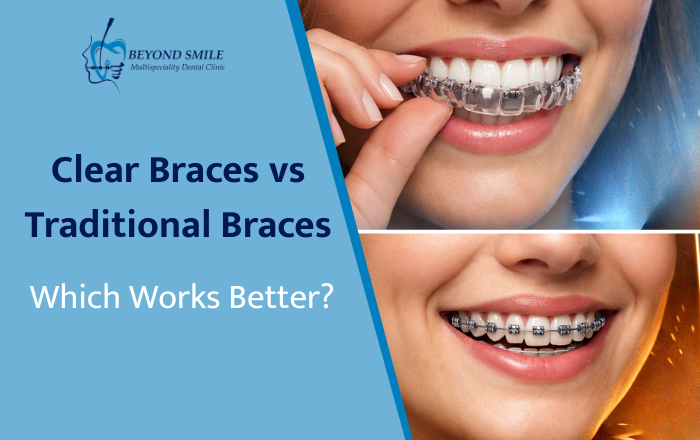
Thinking about straightening your teeth but confused about which braces to choose? You’re not alone. The choice between clear braces vs traditional braces is one of the most common questions people ask before starting orthodontic treatment. Both options work — but they work differently, and what’s right for your friend may not be right for you. Let’s break it all down in plain, simple language so you can walk into your dentist’s appointment feeling confident and informed.
What Are Traditional Braces?
Traditional braces are the classic metal brackets and wires you’ve seen for decades. They’re bonded directly onto your teeth and tightened every few weeks to gradually shift your teeth into the right position.
They may not look the prettiest, but they’re incredibly effective — especially for complex dental problems like severe crowding, overbites, underbites, and crossbites. Traditional metal braces give orthodontists the most control over tooth movement, which is exactly why they’re still widely used today.
Best for: Children, teenagers, and anyone with moderate to severe misalignment who wants the most affordable option.
What Are Clear Braces?
Clear braces come in two main forms:
- Ceramic braces — These work just like metal braces but use tooth-colored brackets that blend with your teeth. They’re fixed, just like metal, but far less noticeable.
- Clear aligners — These are removable, transparent plastic trays (like Invisalign) that fit over your teeth and are swapped out every 1–2 weeks as your teeth move.
Both give you a much more discreet look during treatment, which is why so many adults prefer them.
Best for: Adults, working professionals, and teens with mild to moderate alignment issues who care about appearance during treatment.
Clear Braces vs Traditional Braces: What Really Matters
Effectiveness — Which One Actually Works?
For complex cases, traditional braces vs clear braces isn’t even a close contest — metal wins. A study in the Journal of Clinical Orthodontics confirmed that metal braces offer more precise tooth movement for difficult cases.
However, for mild to moderate alignment issues — which covers most patients — clear braces work just as well when used correctly. The technology has come a long way.
Treatment Time
- Metal braces: 18–24 months on average
- Ceramic braces: Roughly the same — 18–24 months
- Clear aligners: 12–18 months for mild cases, but only if you wear them 20–22 hours a day
The biggest risk with aligners? People forget to wear them or take them out too often, which stretches treatment time significantly.
Appearance
Over 60% of adults say they’d be more likely to get orthodontic treatment if it were less visible (American Association of Orthodontists). That stat says it all.
- Metal braces — clearly visible
- Ceramic braces — blend in nicely, hard to notice from a distance
- Clear aligners — virtually invisible
If how you look during treatment matters to you, clear braces are the obvious choice.
Comfort
All braces cause some soreness — that’s just teeth moving. But here’s how they compare:
- Metal braces can irritate your cheeks and lips, especially after adjustments
- Ceramic braces are similar but slightly smoother
- Clear aligners are the most comfortable overall, though each new tray causes pressure for a day or two
Cost (India Estimates)
| Type | Estimated Cost |
|---|---|
| Traditional Metal Braces | ₹25,000 – ₹60,000 |
| Ceramic Clear Braces | ₹35,000 – ₹80,000 |
| Clear Aligners | ₹80,000 – ₹3,00,000+ |
Traditional braces are the most budget-friendly. Clear aligners are the biggest investment. Ceramic braces sit comfortably in the middle.
Cleaning & Maintenance
- Fixed braces (metal or ceramic) require more careful brushing and flossing around brackets and wires.
- Clear aligners are removed during meals, so you brush normally — but you must clean the trays themselves daily to avoid bacteria buildup.
So, Which Is Better — Clear or Traditional Braces?
The straight answer: neither is better for everyone. The best braces are the ones that match your teeth, your lifestyle, and your budget.
Choose traditional braces if your case is complex, you want the most affordable option, or you’d rather not worry about keeping track of removable trays.
Choose clear braces if you’re self-conscious about appearance, have mild to moderate alignment issues, and can commit to wearing aligners consistently.
The only person who can truly tell you which is right for you is a qualified orthodontist — after examining your teeth properly.
FAQ
Q1. Are clear braces as effective as metal braces?
For mild to moderate cases, yes. For complex cases, metal braces typically give better results.
Q2. Do clear braces cost more?
Yes. Ceramic braces cost slightly more than metal. Clear aligners are significantly more expensive.
Q3. Can teenagers use clear aligners?
Yes, but only if they’re disciplined enough to wear them consistently. Many teens do well with ceramic braces as a middle ground.
Q4. How do I know which braces I need? Only after a proper dental examination. X-rays and bite assessment help the orthodontist recommend the right treatment for your specific case.
Looking for Affordable Braces in Ballygunge, Kolkata?
If you’re in Kolkata, Beyond Smile Dental Clinic in Ballygunge is a great place to start your braces journey. Dr. Dhruvi Parikh, an experienced Orthodontist, and Dr. Ankit Saha, a trusted dentist, offer both clear braces and traditional braces treatment at genuinely affordable prices — without cutting corners on quality.
Whether you’re considering ceramic braces, clear aligners, or traditional metal braces, the team at Beyond Smile will assess your teeth and walk you through the options that actually make sense for your case and budget.
📍 Beyond Smile Dental Clinic — Ballygunge, Kolkata 👨⚕️ Dr. Dhruvi Parikh (Orthodontist) | Dr. Ankit Saha (Dentist)
Book your consultation today and take the first real step toward the smile you’ve been thinking about.